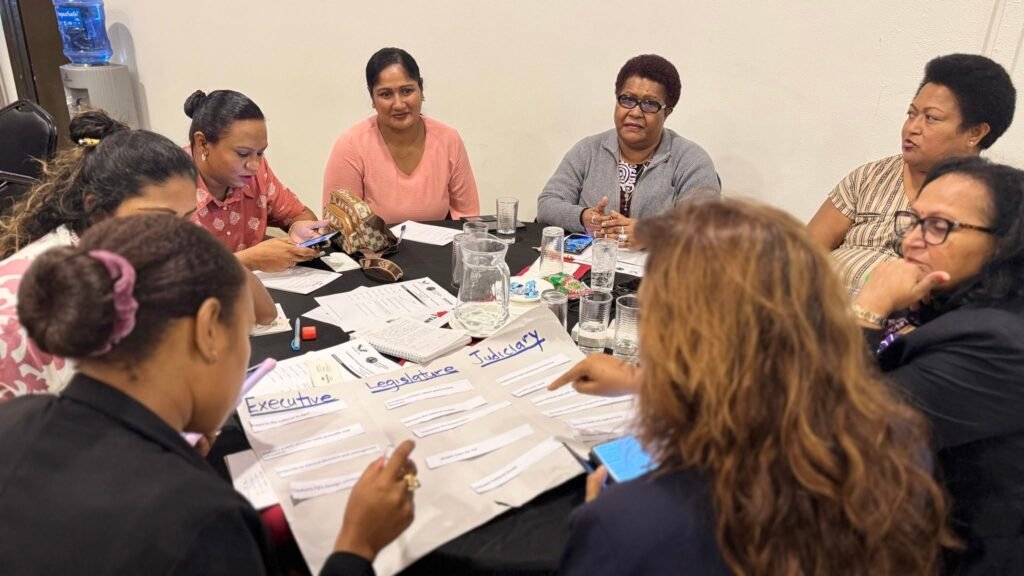
Dialogue Fiji successfully conducted a Candidate Preparatory Workshop for aspiring women and youth political leaders on 3 July 2026 at the Tanoa Skylodge Hotel in Nadi.
The workshop was organised under Dialogue Fiji’s Empowering Fiji’s Women in Politics Initiative, with funding support from Misereor, and formed part of the organisation’s continuing efforts to strengthen the participation of women and young people in Fiji’s democratic and political processes.
The workshop brought together aspiring women and youth candidates, individuals already affiliated with political parties, emerging community leaders, and participants interested in gaining a deeper understanding of Fiji’s political and electoral system ahead of the upcoming General Elections.
While women and young people make up a significant proportion of Fiji’s population, they remain underrepresented in political leadership and elected office. The workshop therefore sought to provide participants with the foundational knowledge, confidence and practical understanding required to engage more meaningfully in politics, whether as candidates, campaigners, party members, advocates or informed citizens.
The programme began with an introduction to Fiji’s political system and the constitutional foundations of governance. Participants explored the separation of powers and the respective roles and responsibilities of Parliament, the Executive, the Judiciary and independent constitutional institutions.
Discussions examined how laws and policies are developed, how public institutions are held accountable, and how the different branches of government are intended to operate within Fiji’s broader democratic framework.
Participants were also introduced to Fiji’s political party system, including the role of political parties in representing citizens, developing policies, contesting elections and forming governments. This session encouraged participants to reflect on how political parties can promote greater inclusion and create meaningful pathways for women and youth to assume leadership roles.
A major component of the workshop focused on the legal framework governing elections in Fiji. Participants were taken through the constitutional and legislative provisions regulating the electoral process, as well as the respective responsibilities of the Electoral Commission and the Supervisor of Elections.
The session covered candidate eligibility requirements, nomination procedures, campaign regulations, election offences, political financing requirements, and the legal rights and responsibilities of candidates. Participants were encouraged to understand that contesting an election involves not only campaigning for votes, but also complying with a detailed legal and regulatory framework.
A dedicated session was held on Fiji’s Open List Proportional Representation electoral system. Participants examined how votes are translated into parliamentary seats, the operation of Fiji’s single national constituency, the role of political parties and independent candidates, and the use of the D’Hondt method to allocate seats.
The session also explored the advantages and challenges of proportional representation, including the relationship between party votes, individual candidate votes and parliamentary representation.
Through practical examples and interactive exercises, participants were able to better understand how candidates compete within their own political parties while also contributing to their party’s overall electoral performance.
Broader discussions were held on electoral fairness, campaign regulations, democratic representation and the importance of ensuring that electoral systems provide citizens with a genuine and equal opportunity to participate in choosing their representatives.
Interactive group activities encouraged participants to compare different electoral systems and reflect on the principles that should guide a fair, inclusive and representative democracy.
Throughout the workshop, participants actively contributed to discussions, practical exercises and question-and-answer sessions. The high level of engagement demonstrated a strong interest among women and young people in understanding Fiji’s political institutions and preparing themselves for more active participation in national leadership.
The workshop also provided participants with an opportunity to raise questions about the practical realities of contesting elections, joining political parties, developing a public profile and navigating the legal and institutional environment surrounding political participation.
Dialogue Fiji sincerely thanks all participants for their active engagement, thoughtful contributions and commitment throughout the workshop.
Dialogue Fiji also gratefully acknowledges Misereor for its generous support in making the initiative possible. Through the Empowering Fiji’s Women in Politics Initiative, Dialogue Fiji will continue working to equip women and young people with the knowledge, skills and confidence required to participate effectively and meaningfully in Fiji’s democratic and political processes.