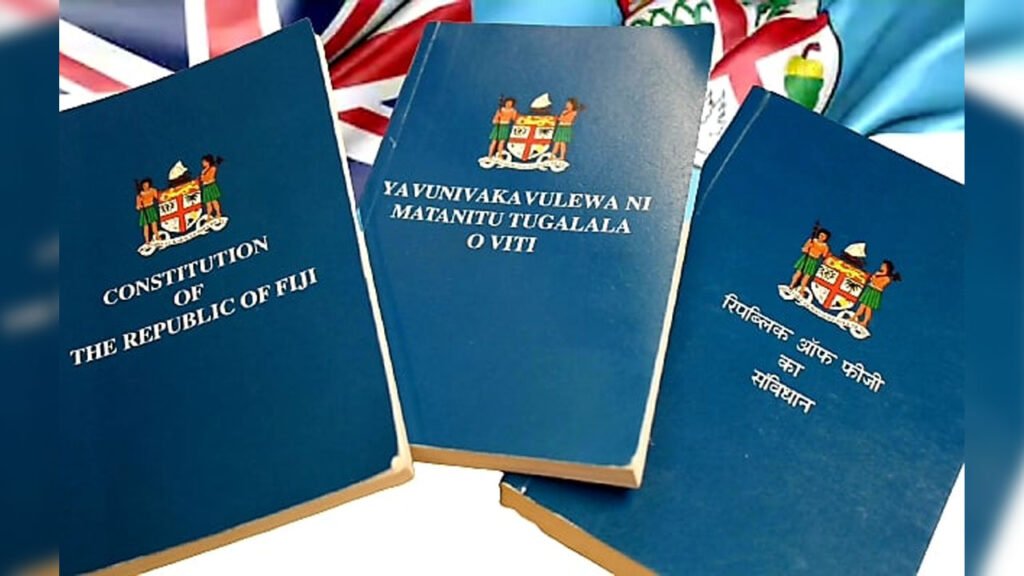
Dialogue Fiji today submitted to the Constitution Review Commission that Fiji does need constitutional reform, but warned that the legitimacy of any reform will depend not only on the text produced, but on whether the process is transparent, participatory, deliberative and trusted by the people.
Dialogue Fiji said the present review process is rushed, opaque and insufficiently deliberative, noting that a five-month process is inadequate for a proper national review of Fiji’s supreme law. It said international experience suggests that comprehensive constitutional reform usually requires careful sequencing, civic education, consultation, drafting, public feedback and final political settlement.
“The core issue is not whether Fiji needs constitutional reform. It does. The issue is whether the reform process is capable of producing legitimacy. A flawed process may produce a document, but it will not produce a constitutional settlement that the people trust,” Dialogue Fiji Executive Director Nilesh Lal said.
The submission argues that the current exercise is, in substance, a comprehensive review because the Commission is inviting submissions on the Constitution as a whole, rather than on clearly identified provisions. Dialogue Fiji said such a process should meet the standards of a comprehensive constitutional review.
Dialogue Fiji contrasted the present process with the Ghai Commission, which it said set a much higher standard for transparency and participatory constitution-making. It noted that the Ghai process involved nationwide public hearings, received more than 7,000 submissions, published those submissions on a central website, and remains widely regarded as an example of open, participatory and well-documented constitution-making.
At the same time, Dialogue Fiji said it does not support reckless constitutional change. The submission calls for the modern democratic foundations of the 2013 Constitution to be retained, including the abolition of ethnic rolls, the single national electoral roll, one person, one vote, one value, open-list proportional representation, equal citizenry, secularism, and a fully elected unicameral Parliament.
“The weakness of the 2013 Constitution is not that it is too modern. The problem is that it combines progressive citizen equality with excessive executive power. Reform must therefore retain the modern democratic foundations of the Constitution, while correcting the structural concentration of power,” Lal said.
The submission makes several key recommendations. It calls for the Constitutional Offices Commission to be redesigned so that it is independent, balanced and not controlled by the executive. Dialogue Fiji proposes equal Prime Minister and Opposition nominees, a Fiji Law Society nominee, an academic nominee selected collectively by the Vice-Chancellors of Fiji’s three universities, and an independent chairperson who is not the Prime Minister.
Dialogue Fiji also recommends strengthening the Public Service Commission, removing the requirement for the Prime Minister’s agreement in the appointment or removal of Permanent Secretaries, and ensuring that Permanent Secretaries serve the State rather than the political executive of the day.
On elections, Dialogue Fiji calls for Fiji to retain open-list proportional representation and the single national constituency, but reduce the electoral threshold from 5 per cent to 2 per cent. It says the single national constituency gives equal value to every vote, discourages narrow regional or communal appeals, rewards parties that campaign on issues of national interest, and removes the possibility of gerrymandering. However, Dialogue Fiji argues that the current 5 per cent threshold is too high for a small and diverse society, suppresses smaller parties, and artificially concentrates representation in larger parties.
The submission further recommends constitutional incentives for political parties to improve gender balance in candidate lists, particularly through public funding criteria, without excluding parties from contesting elections. It also proposes a Cabinet cap of 15 ministers, a two-term limit for the office of Prime Minister, stronger diversity requirements in Cabinet, and clear limits on executive dominance.
Dialogue Fiji also calls for the Bill of Rights to be strengthened through a strict proportionality test, access to information to be recognised as a directly enforceable constitutional right, and judicial independence to be protected through an independent process for appointing the Chief Justice and safeguards against indefinite suspension.
On Parliament, the submission recommends retaining the four-year parliamentary term, constitutionally recognising the Public Accounts Committee as a key oversight body chaired by an Opposition MP, protecting the independence of the Speaker, and imposing strict safeguards on expedited law-making, including any procedure similar to Standing Order 51.
Dialogue Fiji also proposes a citizens’ petition mechanism, allowing citizens to petition Parliament to consider issues of national importance, review existing laws, or initiate discussion on proposed legislation. It says this would not allow citizens to bypass Parliament, but would ensure that Parliament cannot simply ignore issues with significant public support.
The submission strongly urges that Fiji remain a secular State, retain equal citizenry, and continue to recognise “Fijian” as the common nationality of all citizens. Dialogue Fiji rejects the proposed replacement of “Fijian” with “Fiji Islander”, saying that “Fiji” carries dignity and authority as the name of an independent nation, not merely a collection of islands.
“Fiji does not need another Constitution that one side celebrates and another side rejects. We need a constitutional settlement that is modern, democratic, inclusive, rights-protecting and institutionally balanced. Above all, we need a Constitution that belongs to the people of Fiji,”